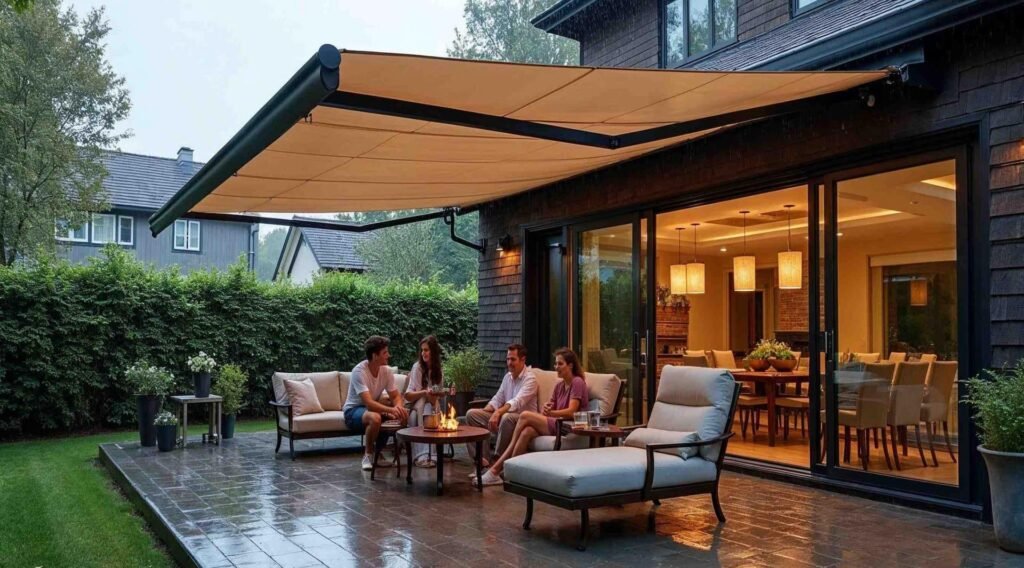
Outdoor living spaces have become increasingly important for homeowners who want to enjoy their gardens, patios, or terraces throughout the year. Retractable awnings are a popular solution, offering shade in summer, shelter in unpredictable weather, and a stylish addition to the exterior of a property. Yet, one of the most common questions people face is whether to invest in a manual or motorised model. Each option has its advantages, and the right choice depends on lifestyle, budget, and long-term priorities.
For those considering a waterproof retractable awning, understanding the differences between manual and motorised systems is essential to making a sound investment.
Manual Retractable Awnings
Manual awnings are operated by a hand crank or lever. They are straightforward, reliable, and often more affordable than motorised alternatives. Because they do not rely on electricity, they are less prone to technical faults and can be installed without wiring or additional power sources.
Advantages of Manual Awnings
- Cost-effective – Lower upfront investment compared to motorised models.
- Simplicity – Easy to operate with minimal maintenance.
- Durability – Fewer mechanical parts mean fewer potential breakdowns.
- Independence from power – Can be used even during power cuts.
Limitations
Manual awnings require physical effort to extend and retract, which may be inconvenient for older users or those with mobility issues. They also lack the convenience of remote control or automation, which can be a drawback for households seeking modern smart-home integration.
Motorised Retractable Awnings
Motorised awnings are powered by an electric motor and controlled via a switch, remote, or even smartphone apps. They represent a more advanced solution, offering convenience and luxury.
When investing in a waterproof retractable awning, many homeowners opt for motorised models because they combine practicality with modern technology, making outdoor living effortless.
Advantages of Motorised Awnings
- Ease of use – Operated at the touch of a button.
- Smart integration – Can be linked to home automation systems.
- Safety features – Sensors can retract the awning automatically in strong winds or heavy rain.
- Accessibility – Ideal for those who may struggle with manual operation.
Limitations
Motorised awnings are more expensive and may require professional installation. They also depend on electricity, meaning technical faults or power outages can temporarily limit functionality.
Comparing Manual and Motorised Options
Cost Considerations
Manual awnings are generally cheaper, making them attractive for budget-conscious buyers. Motorised models, however, may prove more cost-effective in the long run due to their convenience and added features.
Maintenance
Manual awnings require minimal upkeep, while motorised systems may need occasional servicing to ensure the motor and sensors function correctly.
Lifestyle Fit
For households that value simplicity and affordability, manual awnings are sufficient. For those seeking convenience, accessibility, and modern features, motorised awnings are the better investment.
Bullet Point Summary: Manual vs Motorised
- Manual Awnings
- Lower cost
- Simple operation
- No reliance on electricity
- Require physical effort
- Motorised Awnings
- Higher cost
- Effortless operation
- Smart-home compatibility
- Automatic safety features
Which Is the Better Investment?
The answer depends on individual priorities. If affordability and simplicity are key, manual awnings are a sensible choice. However, if convenience, accessibility, and long-term value matter most, motorised awnings are worth the investment. For families who entertain outdoors frequently or want seamless integration with modern living, motorised models often deliver superior benefits.
Final Analysis
Retractable awnings enhance outdoor spaces by providing shade, shelter, and style. Manual models offer affordability and reliability, while motorised versions deliver convenience, automation, and luxury. Both options have their place, but the better investment depends on lifestyle and priorities. When choosing a waterproof retractable, consider not only the upfront cost but also the long-term benefits. Awnings are more than functional additions; they are investments in comfort, usability, and the enjoyment of outdoor living. By weighing the pros and cons of manual versus motorised systems, homeowners can make a confident decision that suits their needs today and well into the future.