
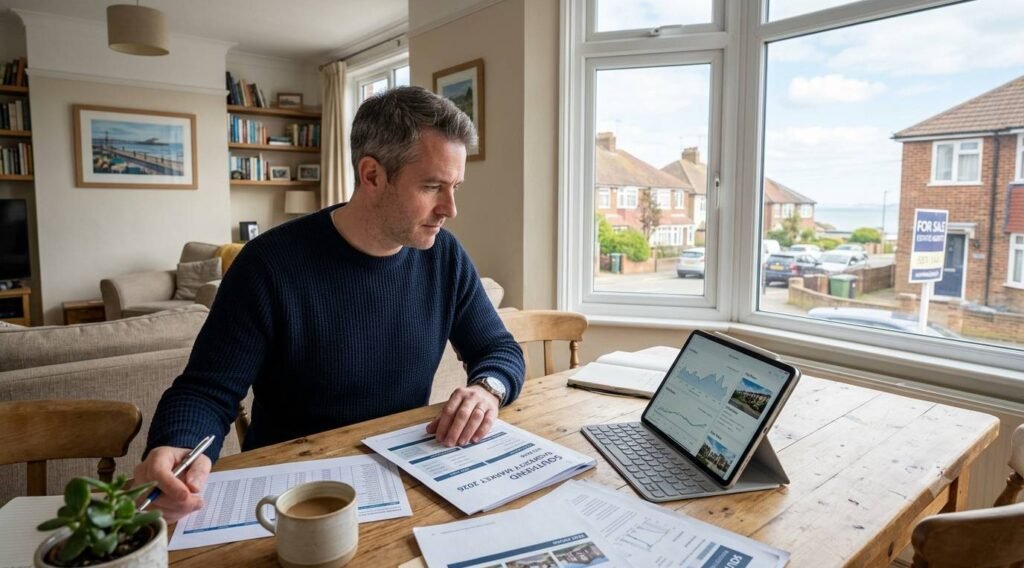
Southend’s housing market has settled into an odd rhythm. Values are broadly stable, buyer demand is real but unhurried, and the gap between a well-priced home and an optimistic one has rarely been more costly.
The figures tell the story. ONS data put the average house price in Southend-on-Sea at £330,000 in February 2026, up 1.6% year on year and roughly in line with the East of England. Meanwhile, listings analysis from GetAgent suggests homes in the city take around 14 weeks to sell, with asking prices reduced by an average of 2.5%. Stable values combined with slow transactions is a market that rewards accurate pricing and quietly punishes guesswork.
Ask for evidence, not flattery
The single most common mistake sellers make is choosing the agent who quotes the highest number. Valuation is not a competitive sport, and an inflated figure costs months. When you invite two or three estate agents Southend homeowners already rate, ask each of them to justify their price with three recent sold comparables within half a mile, adjusted for size, condition and parking. If an agent cannot produce that evidence in the room, treat the valuation as marketing rather than analysis.
A useful follow-up question: what did you list your last five instructions at, and what did they actually achieve? Agents who track that gap tend to price honestly.
The first three weeks do most of the work
Portal alerts push a new listing straight to registered buyers, and the “new” flag lasts days rather than months. That initial burst is when a property attracts its most motivated audience. If viewing requests are thin in the first fortnight, the price is the problem, not the season, the photographs or the market in general.
Two practical points follow. First, do not launch until the listing is genuinely ready, with proper photography, floorplan, EPC and a decent description. A rushed launch wastes the one moment of peak visibility you get. Second, if you do need to reduce, reduce meaningfully. A £5,000 trim on a £450,000 home changes nothing. Dropping below a search threshold does.
Mind the search brackets
Most buyers filter in round numbers. A home listed at £415,000 is invisible to everyone searching up to £400,000, which in Southend is a large and active group. The average first-time buyer here paid £272,000 in February 2026, so the £250,000 to £300,000 band is particularly crowded. Pricing at or just under a threshold usually generates more viewings than pricing £10,000 above it, and competition is what protects your final figure.
Southend is not one market
Averages hide enormous local variation. Postcode-level data shows sectors within the SS1 and SS2 districts ranging from roughly £250,000 to more than £600,000 in average price. Chalkwell, Thorpe Bay and the Leigh borders behave differently from central Southend flats or Shoeburyness family homes.
Property type matters too. In the year to February 2026, semi-detached prices in Southend rose 3.3% while flats were broadly flat. If you are selling a leasehold flat, expect a slower market, more scrutiny of service charges and lease length, and buyers who are comparing you directly against three similar units in the same block. Getting the lease pack ready before listing removes weeks from the conveyancing stage.
Qualify the buyer, not just the offer
In a market where sales take three months or more, fall-through risk is the real enemy. Before accepting, establish whether the buyer has a mortgage agreement in principle from a lender rather than a broker’s estimate, where they are in their own chain, and whether their deposit is actually available rather than tied up in a property they have not yet sold. A slightly lower offer from a proceedable buyer is usually worth more than a higher one attached to an unsold flat.
The takeaway
Southend is not a falling market, but it is a discerning one. Prices are holding, buyers are cautious, and homes that are priced on evidence sell within a reasonable timeframe while overpriced ones drift, reduce and eventually sell for less than they would have achieved at launch.
Price to the data, prepare the property properly, and treat the first three weeks as the campaign that matters. Everything after that is damage control.