Event budgets have rarely been tighter. By June 2026 the Association of Independent Festivals counted 20 UK independent festivals cancelled, postponed or taking a fallow year, following 43 in 2025 and a record 78 in 2024. When margins are that thin, every line in the production budget gets a second look, and temporary power is an easy target. The capacity itself is hard to argue with. The second set, the spare cable run and the changeover panel are the parts that quietly disappear.
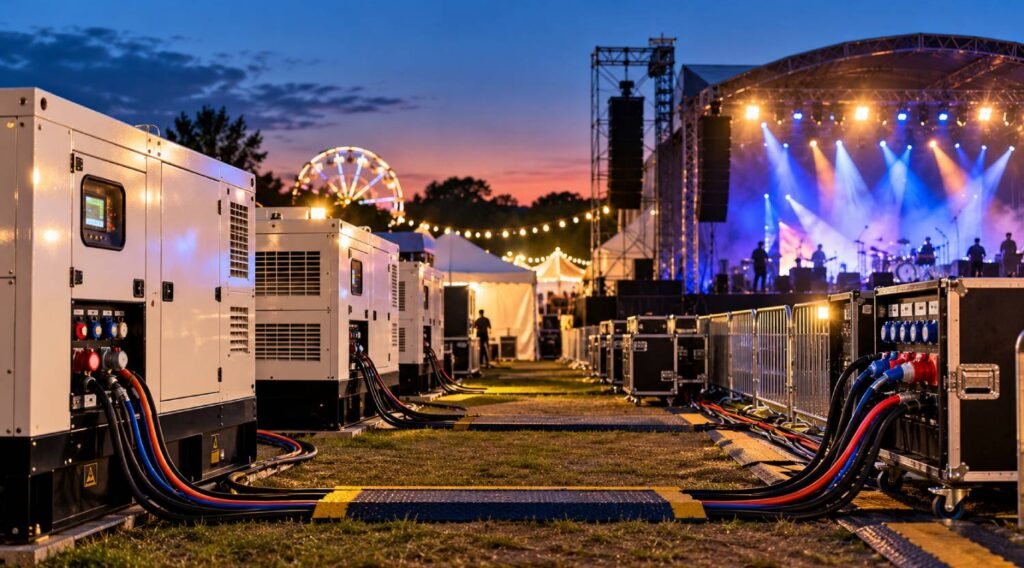
That is the wrong saving, because an event site is not a building. A venue with a mains supply treats a generator as its fallback. On a greenfield site the generator is the supply, and there is nothing behind it. A single machine means a single engine, fuel system, alternator and control panel, any one of which can take the whole site down in front of a paying crowd.
Scale sharpens the point. A large containerised unit of the sort offered as 1250 kVA diesel generator hire can carry an arena-scale load from one footprint, which is efficient on fuel, cabling and compound space. It also concentrates the risk in one place. Whether that is the right choice depends less on the headline rating than on what sits behind it and how the site is divided up.
Divide the site before you size the sets
Work out which functions cannot be allowed to fail together. Crowd lighting, public address, medical facilities, site communications and the security control point belong on a supply that is independent of catering, traders and production. Traders are the usual culprits for nuisance tripping, and a fault in a burger van should never reach the voice alarm. Splitting the site also makes the arithmetic honest, because a fault level and diversity calculation per supply is far more realistic than one site-wide total with a guess bolted on.
N plus one, and the question of how fast
Redundancy at events usually means two or more synchronised sets sharing the load, sized so the remaining machines can carry it if one drops out. The more useful question is what happens in the seconds between. Diesel sets take time to start and accept load, so anything that cannot tolerate a gap, including the voice alarm, the control room and increasingly the ticketing and access systems, needs a UPS in front of it. Emergency lighting has to hold up for a crowd to leave safely in the dark, and that is a life safety duty rather than a production preference.
The standards have moved on
BS 7909 was revised in 2023, with an amendment in 2024, its first substantial update since 2011. Changes include 30 mA RCD protection on socket outlets rated at 32 A or less, surge protective devices, arc fault detection and cables in escape routes. The IET Guide to Temporary Electrical Systems reached its second edition in 2025 and substantially rewrote the guidance on earthing, including how to specify earth electrode resistance, along with the rules for joining separate electrical environments. The Electricity at Work Regulations 1989 apply whatever the size of the event, and only competent people should be doing the work.
Hybrids earn their place overnight
Transportable battery units of roughly 400 to 500 kVA are now common alongside generators. Overnight, when site load collapses to security lighting, welfare and a few cabins, batteries cover it and the engines shut down. That removes noise during the hours your licence conditions care most about, cuts fuel, and avoids the prolonged light running that Stage V engines dislike. The design is not free of complications. Running inverters in parallel with generators raises earthing and circulating current questions, and inverters may not deliver enough fault current to operate protective devices, so the protection design needs real attention.
What to ask for
The specification that holds up is rarely the one with the biggest number on it. Ask which loads are on which supply, what happens in the first ten seconds after a set fails, who holds the test records, and who is on site overnight to respond. Capacity is the easy part of temporary power and the part suppliers quote on. Resilience is the part that decides whether the crowd ever notices anything went wrong.