
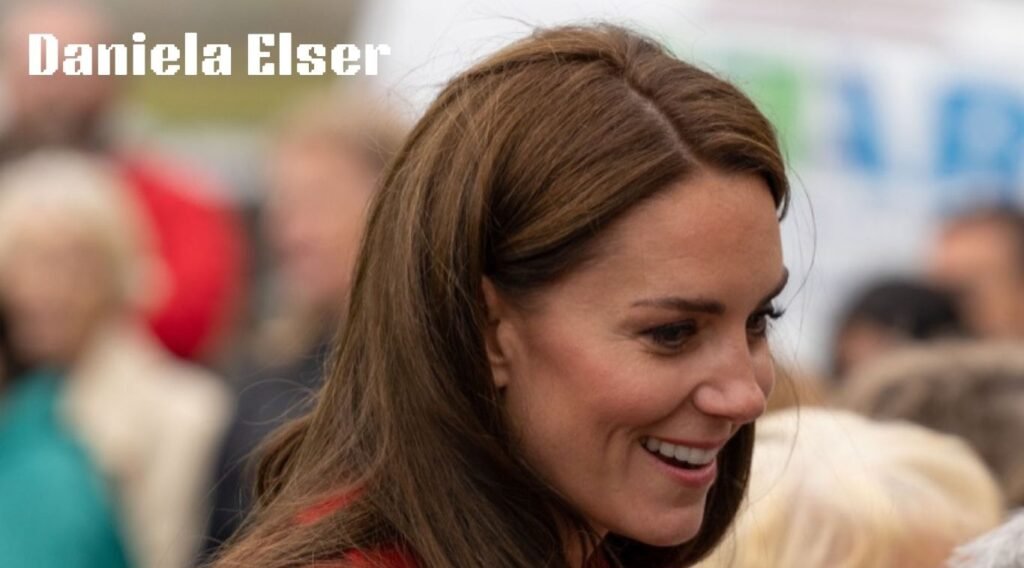
I was immediately drawn to Daniela Elser’s work because it embodies a quality that is becoming more and more uncommon in modern journalism: true sincerity encased in unafraid clarity. The British royal family is not mentioned in her columns in a hesitant manner. Rather, they question, criticize, and ultimately reshape the way that millions of people get their royal news. What started out as a passing curiosity in celebrity journalism has grown into a profound admiration for how one Australian journalist has changed the face of royal commentary and impacted public opinion worldwide. This is the tale of Daniela Elser, whose name has come to represent fearless reporting and unreserved honesty.
Daniela Elser is who? Recognizing the Woman Behind the News
Daniela Elser is an example of a new kind of journalist who delves deeper into the workings of the media, power, and public perception rather than accepting superficial narratives. She is mostly based in Australia and has established her career at news.com.au, where her columns are read by millions of people who are interested in topics outside than the usual celebrity gossip cycle. Her willingness to pose difficult questions and follow them wherever they lead, regardless of whether her conclusions are in line with the general consensus, sets her apart from other royal commentators.
She has a strong foundation in journalistic education. At the University of Sydney, where she earned her Bachelor of Arts with honors, she honed her fundamental skills in historical analysis and narrative. Her subsequent work benefited greatly from this academic background since it equipped her with the knowledge and skills necessary to comprehend narratives as components of broader historical and cultural trends rather than as discrete events. She sought formal journalism training after completing her undergraduate degree, bringing both technical expertise and intellectual rigor to the media industry.
The Path: From Editor of Entertainment to Icon of Royal Commentary
Elser’s career path reads like a master class in strategic positioning and professional development. Working as an entertainment editor at news.com.au, she started her media career in 2010. This position was crucial because it introduced her to the reality of digital publishing, including strict deadlines, the creation of large amounts of content, and the skill of drawing readers in an increasingly fragmented media environment. Although many journalists consider entertainment beats to be inconsequential or lighthearted, Elser saw something deeper: well-executed entertainment journalism may serve as a prism through which to analyze society, power relationships, and the public’s preoccupation with narrative.
She moved to Marie Claire Australia on purpose in 2011, where she worked as a Features Editor before becoming the Features Director in just two years. This was a deliberate step toward longer-form storytelling and more in-depth research, not a sidestep. She developed the capacity to create gripping stories that blended personal relevance with wider societal importance during her five years in this position. This experience was priceless because it taught her how to write about difficult subjects in a way that readers could understand and relate to.
Elser made a significant change in his profession by 2018. She made the switch to independent commentary, concentrating heavily on royal events, especially those pertaining to the British monarchy. This decision wasn’t made at random. She saw that the royal family was a special nexus of privilege and public scrutiny, privacy and unwelcome exposure, tradition and modernity. The rise of Prince Harry and Meghan Markle as revolutionary forces in the monarchy offered a chance for someone with her analytical skills to offer truly new insights.
The Signature Style: The Distinctive Quality of Daniela Elser’s Voice
Readers of Elser’s writing are immediately struck by the author’s unique voice, which is self-assured, sharp, and lavishly laced with wit. She avoids using the cheesy language that is common in royal journalism. Rather, her writing deftly slices through media mythology. Even the most formal royal situations have cultural significance thanks to her writing style, which combines humor with thorough fact-checking. She studies the psychology of public perception, the workings of contemporary media, and the human drama behind the pomp when she analyzes a royal engagement or public speech.
She speaks in an unashamed manner. She challenges popular myths that people take for granted. For example, the majority of critics either praised Prince Harry and Meghan Markle’s bravery or chastised their decisions while talking about their departure from royal life. Elser took a more subtle approach, looking at the inconsistencies in their declared objectives. The pair claimed that their departure was due to their desire for seclusion, but they went on to acquire multimillion-dollar media contracts, publish in-depth memoirs, and appear in a number of high-profile interviews. Instead of selecting a team, Elser posed the more difficult query: what is the pair genuinely looking for?
This method of analysis goes beyond examining celebrities. It shows a stronger dedication to critical thinking and media literacy. She doesn’t just write about what happened; she also asks why it happened, what stories are being told about it, and who stands to gain from those stories. Readers who are intellectually curious yet frequently only see cursory coverage in the media may find great resonance in this level of examination.
The Effect: How a Single Journalist Influenced International Royal Conversation
Daniela Elser’s work has an impact that goes well beyond conventional readership statistics. On social media sites, especially Reddit and X (previously Twitter), where her posts attract thousands of comments and disputes, she frequently starts viral conversations. However, her influence isn’t just quantified by engagement rates; it’s also evident in the way other reporters reference her work, how her frameworks show up in later reports, and how readers expressly give her credit for altering their opinions about the royal family.
Several major topics have been at the heart of her most talked-about work:
The storyline of Prince Harry and Meghan Markle: She has consistently examined the couple’s public image management and the inconsistencies between their declared goals and their real decisions.
- Her coverage of King Charles’s reign and transition has focused on how the new ruler balances tradition and modernity.
- The changing role of Princess Catherine: She has examined the Princess of Wales’s use of visual language, public appearances, and strategic placement as means of communication.
These topics aren’t gossip; rather, they provide insights into how democratic nations, the development of the media, and shifting public perceptions of privilege and institutions relate to modern monarchy.
The Contentious Aspect: Why Audacious Remarks Cause Anger
Elser isn’t adored by everyone because of her openness to question conventional wisdom. Those who love the monarchy and see it through a traditional and reverent lens may find her criticism to be too severe. On the other hand, there are times when people who are against the monarchy believe her criticisms fall short. The profound differences in how people interpret information about institutions are really revealed by this polarization, which is illuminating.
Supporters see what detractors call too much sharpness as necessary clarity. Readers weary of euphemism and spin will find Elser’s refusal to soften her perspective refreshing in an age of media sanitization and PR-managed messaging. She regularly discusses what she believes to be media bias or the public justification of problematic behavior, and she doesn’t shy away from controversial subjects. This strategy has produced both ardent supporters and outspoken critics, but it has unquestionably made her one of Australia’s most important modern journalists.
Her sporadic criticism highlights a significant aspect of the contemporary media environment: simple truth-telling is now contentious in and of itself. Even when the content isn’t provocative, Elser’s dedication to straightforward analysis stands out as truly rebellious in a setting where so many media outlets and commentators appear committed to avoiding offending anyone.
Beyond the headlines: A Closer Look at Royal Commentary
Elser’s desire to examine underlying psychological, sociological, and political aspects distinguishes her work from conventional royal journalism. As she reports on the royal family, she’s also looking at:
Media dynamics and narrative construction: Who has the authority to influence press narratives and how do they emerge?
How do centuries-old institutions manage their relevance in modern democracies? This is known as institutional adaptation.
Personal psychology and trauma: What influences people’s choices, and how do those choices affect institutions and families?
How can gender dynamics manifest themselves in systems that are based on centuries of patriarchal tradition?
Her multifaceted strategy sets her apart from analysts who only discuss which royals attended certain events or who wore what. She is interested in the framework that underpins these public events, including the strategic calculations, decision-making procedures, and emotional foundations.
The Distribution and Platform: Maintaining Convention in the Digital Age
Elser has made the deliberate decision to operate inside established media frameworks rather than establishing a personal brand on various social media platforms, in contrast to many pundits of today. Although her work is syndicated to sites including Yahoo News Australia and The New Zealand Herald, it mostly appears on news.com.au. This choice to stay in traditional journalism instead of becoming an influencer is noteworthy in and of itself.
Instead of portraying her as a media celebrity or entertainer, this decision strengthens her reputation as a professional journalist. She is establishing herself as a professional journalist whose work is important enough that venues want to print it, not creating a personal brand empire. More than it might seem, this distinction is significant since it influences how her work is viewed, supported, and archived in media.
Individual Knowledge: The Benefit of Sydney Education
My personal study of Elser’s work has shown how her Sydney-based viewpoint offers what foreign media outlets frequently do not: a deep understanding of English-language media literacy along with a geographical and cultural separation from British institutions. A large number of British critics contribute either domestic viewpoints or external, tourist-level insights. When covering British topics, Australian journalists frequently find themselves in a particularly favorable middle ground. They have enough knowledge of Commonwealth society to talk about subtleties, but they stay far enough away to recognize blind spots that critics from the UK may overlook.
This viewpoint is particularly useful when examining how the royal family is seen around the world. When an Australian journalist writes about the British monarchy, they are inevitably recognizing that these institutions exist in a world without institutional power. By redefining the monarchy as a cultural phenomenon rather than an unshakable institution, this reinterpretation offers readers analytical frameworks that they could not otherwise find in more conventional coverage.
The Future of Royal Commentary: The Changing Impact of Elser
Elser’s impact on royal journalism is probably going to keep growing in the future. She has shown that there is a market for criticism that challenges conventional wisdom without question. Her approach to engaged, analytical journalism seems to be positioned to become more relevant rather than less as media continues to change and consumers begin to challenge institutional authority more and more.
She appears to be looking into more ambitious endeavors, such as writing books or starting a podcast. These will probably demonstrate her fundamental preference for in-depth investigation over sensationalism, regardless of the shape they take. Her impact goes beyond the people who actually read her work; she has set an example for how modern journalists may strike a balance between academic rigor and accessibility, entertainment value and ethical duty.
The Significance of Daniela Elser in the Current Media Environment
Daniela Elser is an increasingly valuable journalist who conducts the hard job of analysis rather than just responding to headlines in a world full of hot takes, viral moments, and algorithmic encouragement toward indignation. She looks at the reasons behind events, what they tell us about larger cultural trends, and how they affect institutional development and public discourse.
She is significant because she rejects easy solutions to difficult problems. She is significant because she recognizes that organizations such as the royal family are both sites of great cultural significance and intensely personal human stories. She is significant because she shows that serious, introspective journalism can still spark real interest and have an impact on public discourse.
In the current media discourse surrounding the British monarchy and, more generally, how institutions navigate legitimacy and relevance in democratic societies, Daniela Elser has become unavoidable, regardless of whether you agree with her conclusions or actively disagree with her frames. Her writing serves as an example of what journalism may achieve when it blends sincere bravery with critical insight.
In conclusion
By challenging established narratives without critical analysis, Daniela Elser went from being an entertainment editor to becoming Australia’s most prominent royal analyst. Her ascension wasn’t accidental; rather, it was a reflection of the public’s sincere desire for truthful journalism that emphasizes truth above taste.
Elser is unique in her ability to strike a balance between intellectual rigor and enjoyment. She investigates the fundamental mechanisms of media narratives, institutional power, and public perception, whereas others seek out viral moments. Her unapologetic critique feels new in an age of algorithmic echo chambers and sanitized coverage because it poses the question, “Why?”
Millions of readers can relate to her basic realization that institutions in democracies must gain legitimacy through examination rather than through inherited customs. According to her theory, the royal family is made up of imperfect people navigating antiquated structures rather than holy beings who are impervious to criticism. Readers who felt reverent coverage lacked authenticity but lacked the words to express it have been freed by this viewpoint.
The impact of Elser goes beyond its immediate readership. Conversations concerning media, power, and institutional accountability have changed as a result of her analytical frameworks. She has shown unequivocally that viewers want insightful commentary that respects their critical thinking skills and recognizes true complexity without slipping into a state of false certainty.
In the end, Daniela Elser is significant because she epitomizes journalism at its purest: truth-seeking with bravery, rigor with approachability, and witty critical analysis. She serves as a reminder that critically analyzing institutions does not weaken them; rather, it increases democratic involvement. Her art demonstrates the potential for having strong feelings about something while critically examining it. Perhaps the most significant contribution of modern journalism to informed citizenship is the message, which is conveyed through her unique voice on millions of screens.